Tuesday, August 16, 2011

Vive el Ebro - Episode VI


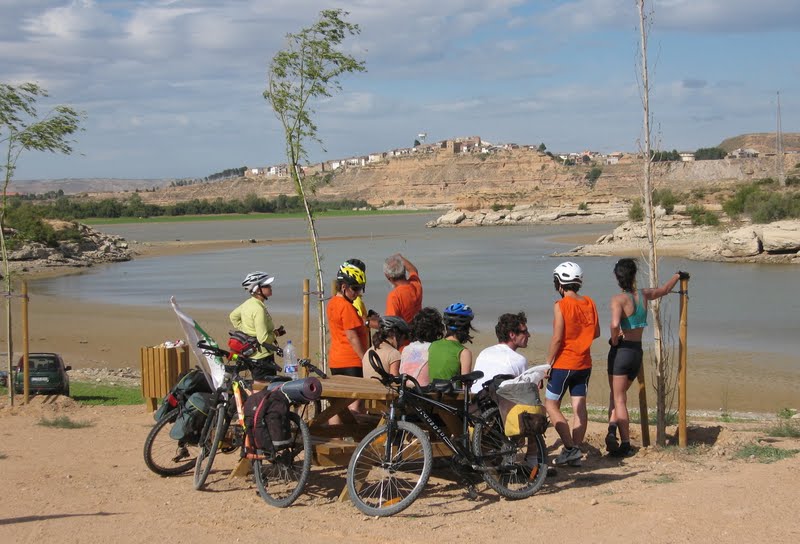
Caspe-Mequinenza (42 kms)
It’s a hard day today for our cyclists, not just because of the lengthy climb and heat, but also because the decision was made to use the NA road, in order to make the route shorter (40 kms as opposed to 80 kms) and not get into excessive heat problems; but this road is loaded with crazy truck drivers, that pass the bikes along solid lines, curves with no visibility.
Mequinenza is the center of this enormous dam, the actual town is currentlt underwater along with a few others, the only original building is the historic castle, used by the Reyes de Aragon in Medieval Spain, however nobody is allowed within 200mts of it, as the recent  mayor, sister of the owner of the power plant has been in charge, and she too had denied us to stay in the “poli”. But we knew this before coming, so arrangements had been made to stay at the Albergue, 18euros p/p. A few of us went to a camping for about half as much.
I found nothing interesting about this town, which while in the province of Zaragoza, Catalan is widely spoken even in schools for it’s proxinity to Catalonia. The only tourist attraction here is fishing the SILURO (Silurus Glanis), which was illegally introduced here in the 70’s as a young fish, and they have grown sometimes as much as 300 pounds. Anything worth seeing has been buried underwater.
Mequinenza-Almetret-Flix (43 kms)


This morning was a great feeling, not just because I was anxious to leave Aragon, but because when we arrived to the town of Almetret, the towns people received us wearing their own statement Tshirts and banners. They were so happy that we made it to their small town, Albert tells us of their struggle against the polluting corporate power giant, and how they feel powerless being such a small community, and how their spirits are lifted with our presence and support. Makes you wanna cry...a little bit.

After a late breakfast in Almetret. Albert and Jordi show us where to take the right path to Flix; so Annelies (who’s my copilot today) and I follow the bikes down this crazy bumpy road, something you wouldn’t dream of doing unless you were 4 wheeling, but there was no going back now. Suddenly the canoe on the roof slid onto the windshield...we looked at eachother and laughed our heads off, and I climbed on top to tie it down.

We arrived at the Parc Nacional del Bosc de la Ribera de Sebes, where Pere Josep, the director gave us a lecture on the problems created in this area by Erkimia, a chemical company established here back in 1898, which in just the last 40 years have created over 400,000 tons of toxic waste, to which some brianiach decided to build a containment wall and to continue filling it with more waste.
Annelies gave an interview to local tv station.

Another local issue was the fluvial transport, a couple hundred traditional boats were bought by Asco Nuclear Power Plant and burned to cinders, to avoid having to find a solution for continued navigation; doesn’t that remind you of GMotors buying and destroying Los Angeles amazing public transport?
Currently another problem is seeing many people sent to hospitals in the Delta area, as a local tiny fly known as “la mosca negra” has become a plague, since the lack of sediments creates giant weeds that boosts the flies.
Already in Flix, after a very late lunch, we discover the man working in the kitchen of the small restaurant, Rafael Castro, was fired from Erkimia, the chemical plant, for refusing to cover up the waste being thrown directly into the river. I take over his place in cleaning up the dishes in exchange for a short interview.


We took a brief trip on the transborder, and later in the evening, Jordi and I went to scout the area in front of the nuclear power plant, in order to find the best spot to take photos and deploy the canoes the next morning.


Flix-Asco-Miravet (44 kms)

Last night was caotic, as the organizers had diverse opinions on today’s plan, while some were on the verge of a nervous breakdown, we said screw it as nobody was listening. Despite the anxiety, the stand was a success; Jordi joined the canoes together with Chusa, a wonderful ornithologist (bird watcher) from Santander. After the manifesto, the canoes continue to Mora de Ebro for lunch, and the bikes stop first in the town of Asco for a quick snack.
After lunch Demelsa and I take Jordi’s canoe to our final destination of Miravet, about 13 miles or so, and while I would have liked to take the camara with me, after a series of previous incidences, I thought it best to leave it in the van with Jordi and Wilbur.
Once in Miravet, the mayor comes to gives us a speech about how his small town is struggling, not receiving any government grants, while other wealthier towns get it all, because they play ball with government officials and big corporations.

Sunday, August 14, 2011

Vive el Ebro - Episode V

Zaragoza-Zuera-Zaragoza (60 kms)
The group travelled 30 kms NE towards Huesca this morning in order to meet with another cyclist group from Columna Rios Vivos and share lunch together, however the parc area selected in Zuera did not offer a large enough shade for people to stay together, the group was split, but for the time we took to take the group photo.
As we were gearing up to leave and head back to Zaragoza, we began to notice flat tires, lots of flat tires, more than 20 bikes had flats, some had upto 5 holes, and we found the culprit, a dry weed with some nasty spikes in this parc; even Demelza’s and my own that had arrived via van were flat. This caused another hour delay.

Before leaving to the next event this evening, Diego leads an assembly, mostly to inform all about logistic problems in the next few days, aswe are going to be heading down to some hard ass corporate monger type controlled towns, that refuse to give us shelter, so we will be making more noise than usual.

There was a showing @ 9pm of “Voces do Brazil”, but by the time we made it to the locale it was 10.30pm, so we went to dinner at barrio de la Magdalena, later went back to the locale to join a party, had a drink, after which some of us made it club named “Crapula”, where “la pena” was dancing to some basque punk rock, a particular song came on and the crowd (me too) created a lite style mosh pit in which we were “bumping into each other” (no pain involved), we went back to sleep earlier than others, as tomorrow we depart at 8am, for no other reason than to avoid excessive heat, as we will be travelling through more dessert like terrain approaching “los Monegros”. Diego suggests we may be needing to go as early as 6am in the next few days, depending on weather conditions.
Zaragoza-Pina de Ebro (52 kms)
First stop today is in Burgo de Ebro, where a local “cacique” chose to build a concrete wall, covered it with land and grew wheat right on the middle of a public path to discourage hikers and cyclists from using it. The local environmental tecnician sued him, so the cacique of the Yarza Family used his influence to have him fired from the city hall. When Ecologistas in Accion found out, they went to cut down the wheat and found the local “Guardia Civil” waiting for them, as they too are corrupt in this area, but the activists went ahead with their objective, and filed a new suit. Our group is now there to bring media atention to the situation and make all this corruption come to light.
From what I’ve been learning these days, Ecologistas en Accion, is an international organization (have not had enough time yet to dig in), and are more powerful in Spain than Green Peace or any other activist group, with more members, supporters and sympathizers, due to their media attention grabbing stunts...hey! what ever works, right?

Our final stop today, Pina de Ebro is currently the first true difficulty, as we found out only yesterday, while we already had an invitation to use the “polideportivo” to spend the night by the city hall and towns people, the current mayor and royal “biatch”, Maria Teresa Martinez, and behind the council members back, filed a decree to not allow us the space, since she found out the group is supporting a platform to stop a plan for a new lead factory, in which she has vested interest in.
Of course all of our media people were busy most of the day yesterday after this discovery,  so by the time we got to Burgo, well before Pina, we were already reading about it in the local papers, although not front page, because some psicopath went ballistic in Oslo in name of religion, hate and racism. Also in the news was the culmination of a march that had begun some days ago, 15M indignados from different parts of Spain (north, east, south) had converged at Plaza de Sol in Madrid. Also in the news the untimely death of Amy Winehouse.
Anyway, we don’t have the “poli” tonight, but we have two other much smaller facilities that the town folk arranged, but a good number of tents were also set up in the town plaza, right in front of the city hall. Meanwhile some town people already expressed their interest in singing along as Marta got busy last night coming up with something to honor the dictator Maria Teresa, while we ride along in circles with the bikes in the town square.
I have not felt so alive since the “opening” of Green Home Center, the world needs change and it looks like we’re taking our first steps.
Pina de Ebro-Caspe (68 kms)

Manolo (Madrid) and Juan (Málaga) had asked to take the canoe for a spin, so I drop them of at the river beach and drove about 15 kms of what seemed like Camel Trophy Expedition terrain, down river to find a spot they could easily carry the canoe out of. I found one of those old transboarders, pulled out my book and read for a little over an hour, till they appeared.
We chatted for a bit, while heading toward Monasterio de Rueda, where we planned to have lunch, after a tecnical stop for photos in front of another power plant.
Juan told me he had a canoeing business in Malaga, that he was forced to give up, as the city hall/government kept demanding more and more of him. Manolo, a public health care veterinarian, spent a few months working for the Obama campaign in Ohio, simply getting people registered to vote, since he was visiting his then american girlfriend.

Before lunch I went with Jordi to visit the monasterio, and ran into a man from Premia de Mar, as he was teaching his grandchildren Samuel, Dimas and Edna how to fish.


The town of Caspe doesn’t have much to offer, despite money behind a few, most people have basic to less education; we were advised to place all of our vehicles also into the poli.
This is Diego being interviewed upon our arrival.

A huge dam that creates what is known as “Mar de Aragon” is rataining most of the sediments that are badly needed further down river and at the same time are creating problems at the dam. A group of well paid engineers thought  the best way to take the sediments down would be to truck them....seriously!

Jordi and I chose a kebab/falafel joint for dinner at the town square, since neither the local food or wine is desireable in these parts. We began adding tables, as more group members showed up, and Natalia who has an amazing head o her shoulders, leads a conversation on how to create “teatro participativo” or “del oprimido” (sorry I lost my notes), but it was very interesting, where a situacion is created with an unhappy outcome, and the public has better ideas, so they are asked to come on stage and become a character that may change the ending. The scene is repeated as many times as necesary, with as many partcipants that may have alternate solutions, till the public is pleased.

Wednesday, August 10, 2011

Vive el Ebro - Episode IV


Alfaro-Castejon-Tudela
A local member takes us for a tour of the sotos, an area often flooded by the river, where a simple plank of driftwood soon becomes a small island, larger, or a peninsula, the river constantly shifting and changing.

We pick fallen peaches along the way.


This morning I’m riding my loaned bike, however I caught a flu the previous night, and congestion keeps me up all night long. I thought that by exercising with the pedals might help strengthen my inmune system, but as we head over to Castejon, I feel weak, and by the time we hit the third power plant, I feel faint and feverish, I lay on the ground to guard from the wind and call Jordi to come back for me with the van, as he is already half way to the small city of Tudela, our next lay over. 
Jordi tells me that his daughter warned him not to mention he’s her father around these parts, since Aida is a known activist for AnimaNaturalis, and these parts are still strong when it comes to animal abuse like bull fighting; so when Aida and her vegan friends come to these parts in buses to do their peaceful demonstrations, they have been received by crowds throwing rocks at them. This also happened in Tordecillas, where another form of torture is big, a few dozen macho guys on horses spear the bull over and over.
The next couple of days are a bit fuzzy for me, when we make it to the poli, I just drop myself onto a large gym mat and sleep for 3 hours straight. When I wake up, we hop on the bikes toward downtown to find a place for dinner.
Tudela- - Pradilla del Ebro

Wilbur and I drive the van behind the bikes, although the first 3 hours I got lost, probably due to the fever. I run into Jon, the illustrator from the Delta, who is also a little lost as he is searching for the boats, so we hang out for an hour or so, chatting about graphic novels and Zeitgeist.
I find the bikes, but I don’t remember much, I just collapse again when I make it to Pradilla del Ebro. Never even saw the poli, rather stayed and camped in the park. There was a soccer field and a town swimming pool next to the park, were a bunch of the group went, but I just wanted to sleep.
A quiet evening, Polet was teaching some people how to play “virles”, a very old moorish game and predesesor of bowling.


Adrian from Cantabria arrives, he left home on Sunday and just today rode an unbelievable 200 kms.
I also meet Leo and Juan, they came from Malaga.
Pradilla del Ebro-Zaragoza
I told everyone I was not driving or riding today, simply sleeping. The group takes off, Jordi is driving, first we acompany a girl from Huelva and her bike to catch a bus in Pedrosa, as she needs to get back to Alfaro, where she left her car a few days ago.
Then we go to Cabañas de Ebro to wait for the boaters, and we find out they’ll be about 3 hours, so we have some lunch at the one and only bar in town, and we go to take a long nap by the river. Wilbur wakes me up to let me know the boats have arrived. Jordi helps unload bikes and load boats to procede to Zaragoza, which is the largest city along the Ebro river; much larger than I remember it. Someone went nuts overbuilding here, the area where we are staying is by the Expo, huge modern design pavillions with hanging gondolas, are empty, unused, such a waste.
3 days here in the big city, so hopefully I will start to feel better in order to enjoy it. We unload the van and head straight to downtown area in hopes to find a store open to buy some ground meat for Wilbur and a Pharmacy to get some sea water to clear my congestion, but keep in mind that the stores close between aproximately 2pm-5pm, it’s 4.30pm now and we need to be by under the Third Millenium Bridge at 5.30pm. Jordi takes the opportunity to visit a customer for a repair that takes only 10 minutes, and we find the sea water next door.
The guy who the group arranged to rent the canoes from for a river protests, screws up the evening and leaves me in charge of watching over 27 bikes. Fortunately the sea water and other magic potions (provided by Patxopa) are starting to take effect, and while still tired, I no longer feel fever, at least for a while. Jordi leaves to find food for Wilbur.
4 hours later the bike owners show up, grateful for keeping their bikes and recognizing the canoe people didn’t keep their promise to deliver the bikes down the river. By this time I was upset and more tired, but it got worse, as the same screw ups had also told us they would bring back Jordi’s canoe, and abandoned it somewhere along the river, and we spent another +hour trying to find it in the dark.
Zaragoza
Due to what happened yesterday and taking in Concha’s advice (who I miss dearly, as she went back home to Logono), I began this day with the word “no”, which is what I said to MariAsu when she asked for my bike this morning.
Ignoring what the plan was today, the fever was gone now, Jordi and I went to town with the bikes to find a spot for breakfast, after which we found the Aljaferia, an old moorish castle, that has suffered may sad “remodels” over the years. We decided to pay the entrance fee 6 euros, toured the palace and ran into Javier and Miguel Angel from out group. As we exited, we also ran into Samuel and Maite, who gave us a great suggestion for lunch, Casa Emilio.

After a short siesta at the poli, we take the canoe down river to take some photos. At one point some strong cross currents almost tip us over, I was able to convince Wilbur not to jump out. By chance we happen to join the rest of the group down river, by the stone bridge, as they were just starting the pirate water war, followed by an assembly in la plaza directly behind el Pilar, the renown cathedral. Juan Carlos, a local farmer joins us, and talks to us about the problems with seeding crops due to climate change, in March can cause rotting during flowering due to flooding, April also can cause freezing if only for a single night, some farmers have even been seeding in September; regardless they average at least 20% losses. We also talk about 400% increase in phosphates and nitrates, controlled by China, and the problems caused by “transgenicos”, Aragon Region is the area of Spain with the most, and how the contaminate other farms.


Sunday, August 7, 2011

Vive el Ebro - Episode III

Logroño-Arrubal-Logroño

Found my camera, yeah!
Today is my saint day, July 16th, I hopped on the bike this morning, but a series of unfortunate events forced me to stay at behind at the Poli; and since we are staying here another night, I took the oportunity to do some laundry and enjoy some great conversations with akin people. Marisa, the MD from Santander, with whom we shared laughter and stories, left behind a paper with a beuatiful fairy legend of how the Delta was formed, as she is going home today, with hopes to rejoin the group further down river, and she did not find the right moment to read the story, so she left me in charge to pass it along; which I will do later this evening.


Around 6pm a group of us made it to a nearby swimming pool to cool off, and later at 8pm to the embarcadero to see aspectacular show, super energetic, funny and involved group of Batukada. I was mesmerized.


Later, around 10pm, we made our way to a small street downtown, “Calle de los Baños”, to the center of the CNT, the local anarchist group, who invited us to a delicious vegan dinner; each individual had to serve him/herself, clean your own dish and cup, and store your chair when done. After dinner the same space, that was actually an old theatre, became the evening entertaint, with a very unique group of musicians, the drums were all made from recycled parts (frying pan, empty containers, etc), and their music was versatile: punk, rock, flamenco, pop, etc; and the performance was hilarious and fun.
Logroño-Lodosa-Calahorra (64kms)
Morning light rain, Iosu (Ibai’s dad, who left due to his injuries) came with me in the van, because the steering on his bike is broken and since today is Sunday, he can’t find anything open. I don’t want to miss the visit to the Würth Museum, that the group did yesterday morning; so we head out there, followed by Maria Antonia who also missed it, as she hurt her wrist and has decided to head back home to Valladolid, where at 63 has an organic vineyard, struggling to bottle her wine.
Würth is a very popular hardware manufacturer (nuts and bolts), who has an extensive collection, and much like the Getty Family, believe art should be available to everyone, so it is also free admission, they even have a free shuttle to Logroño.
I’m told the exhibits change, they have one area where they displays chronologicaly, one piece of each year the company has been in business since 1930 to date. I was in awe of the entire visit, both the building which is next to the factory, in an industrial area, and the exhibit are fabulous.
We said goodbye to Maria Antonia and made our way to Lodosa, where the town had prepared a delicious stew picnic by the river. Lodosa is known to be the world capital of the bell pepper, pimiento.


After lunch the cyclists moved on to Calahorra, the vegetable capital, while the support vehicles at Iosu’s request made way to Sartaguda, also known as the widow town, where Franco killed all men of all ages and buried the on the side of the road, brutalizing women, some of which also died; and till very recently were these families allowed to dig up their bones and give them proper burials and build a memorial in their honor. They were killed because the church didn’t like free-thinkers, as all working class whether farmers or factory workers were anarchists in nature when the facists began the civil war. Being there was terribly sad, I had goosepumps and tears.
In Calahorra, we all enjoyed dinner at the youth hostel, provided by Guillermo, the local ecologista member. After dinner half of the group left to the next small town as there were not enough beds for everyone.
Calahorra-Rincon de Soto-Alfaro (38kms)
The cyclists followed Guillermo for a tour of the organic produce farms.
Iosu went to the local bike store to get his bike fixed.
Nerea hopped on the van with me, and we followed Annelies to the next stop, Rincon de Soto, known for it’s pears.

Next to Alfaro, currently celebrating it’s baroque festival, by the time we get to the “polideportivo”, Nuria and Patxopa are cooking up a delicious organic meal for lunch.
Jordi and I went for iced coffee at the town square, observing the fabulous cathedral, we were surprised to see storks all over the roofs. The town people tell me they are there all year but for one month when most, not all leave.
In the evening we all take off for critical mass, Wilbur follows on foot; and stopping to talk to town folk, who are wonderfully receptive; one woman asks if we can stop in Castejon, where 3 power plants are located; I assure her we will; another elderly woman wants to know if she can be of help, and offers two spare beds in her home; I assure her we are well taken care of.
We all climb up to the vista point for a better look at the storks, where Carlos (Bruno and Violet’s dad) gives us a bit of background on stork behaviour; white storks , like the ones we are seeing are group birds, while black storks are loners that stay by the river beds. Concha tells us how they came up with the idea to place supports for the nests, as the weight, up to 500kgs, as they build over the old nests, was becoming a problem for the church roof.
After dinner, a few of us went to visit the Miniature Bicycle Museum, located inside an asador restaurant. I told the owner about an old newspaper article that my grandfather showed me, from 1931, where my grandmother Adela was mentioned as this first woman to compete in a cycling race. He asked if I could send him a copy for the museum, but sadly that was stolen and lost along with the rest of my heritage by my mother’s evil sister.
I have to say though, my grandmother hated riding bikes, think how bikes used to be, wooden seats, no suspension or gears; but she did it to please my grandfather.


been working on my photo album